Figures

Working Paper · Bell Inequality Analysis · 2025
A computational rebuttal of Wang et al. (2025). Post-selection artifacts — not quantum nonlocality — explain the reported CHSH violation.
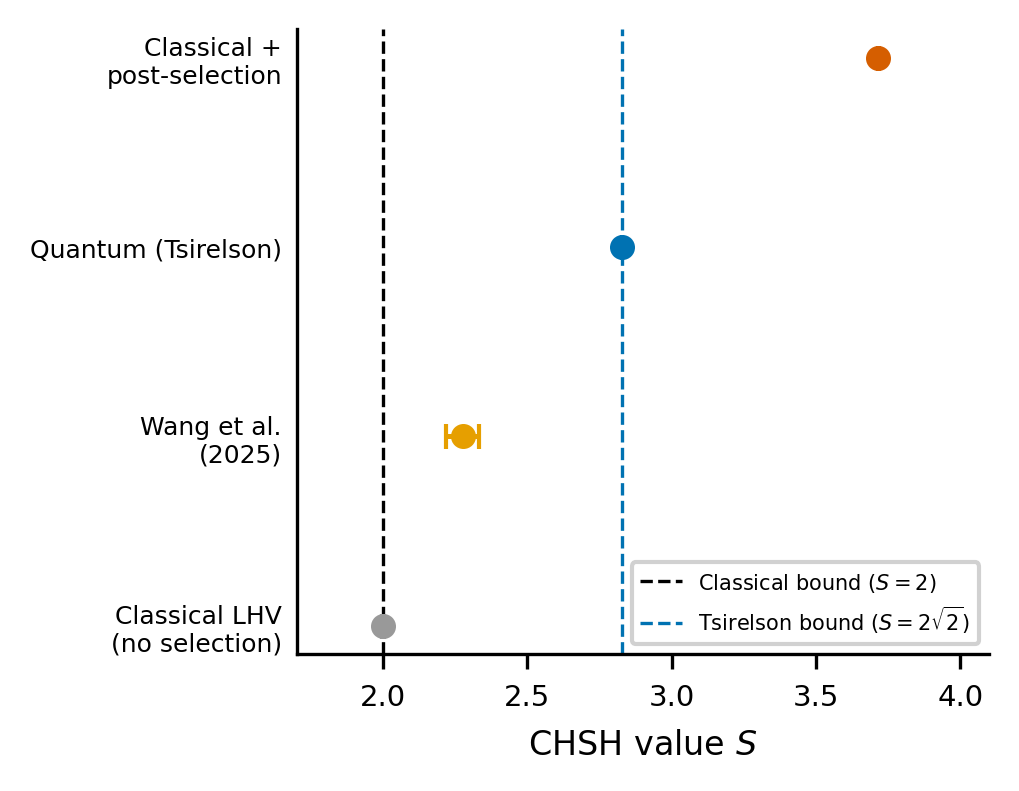
A recent paper in Science Advances claims to demonstrate Bell-inequality violation without entanglement, reporting a CHSH value of S = 2.275 ± 0.057 at a detection efficiency of roughly 10−18.
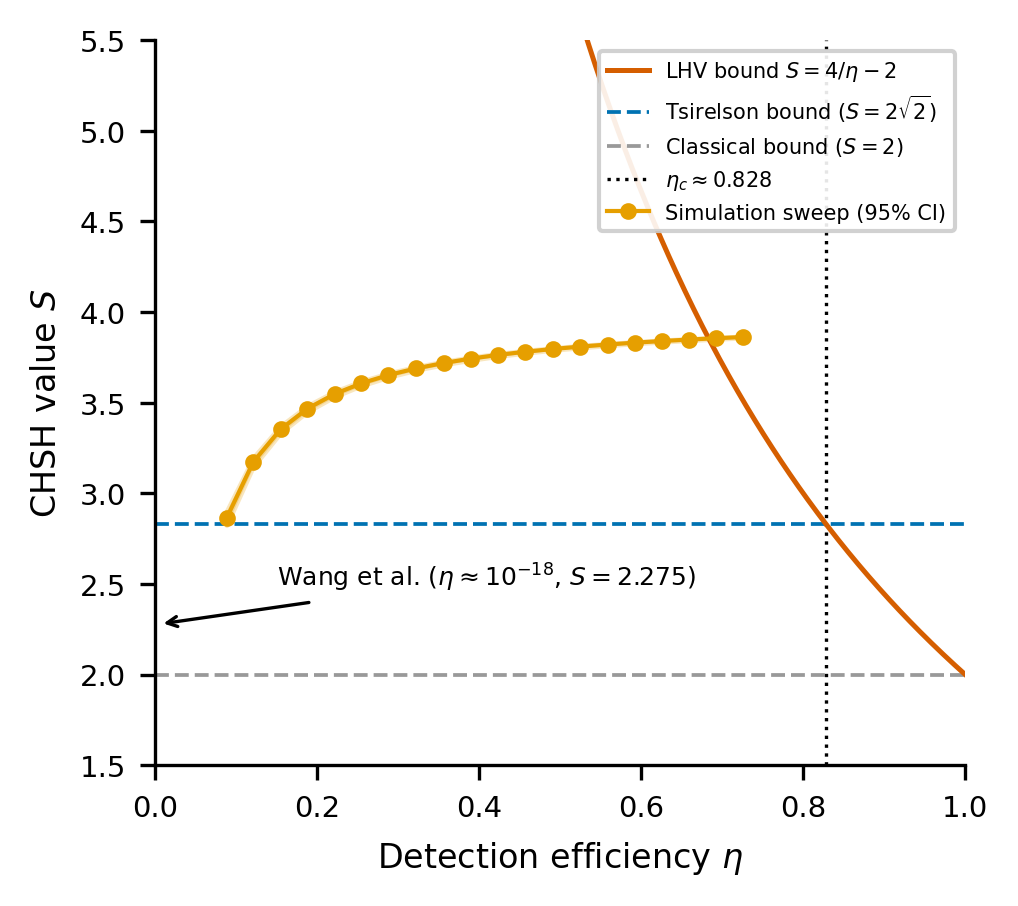
The CHSH inequality holds for any local hidden-variable (LHV) model operating on all detected events. When detection efficiency falls below the critical threshold ηc ≈ 82.8%, post-selection can inflate S above 2 for purely classical systems. The reported S = 2.275 is not evidence of quantum nonlocality; it is evidence of a detection loophole.
We demonstrate this with explicit simulation: a classical LHV model with outcome-dependent post-selection consistently yields S ≈ 3.72 — a value that exceeds both the classical bound (S ≤ 2) and the quantum Tsirelson bound (S ≤ 2√2 ≈ 2.83). Wang et al.'s result lies below what we achieve with no quantum mechanics whatsoever.
The critical efficiency follows from the CHSH analysis itself: ηc = 2/(1 + √2) ≈ 0.828. Any experiment below this threshold requires the fair-sampling assumption, which cannot be verified from the data alone. We provide a straightforward diagnostic protocol for future experiments.
For a given detection efficiency η, the maximum CHSH value achievable by a classical local hidden-variable model with outcome-dependent post-selection:
Three physical models — LHV, quantum singlet, and post-selection — with parameter sweeps, reproducible seeds, and CSV output.
Structured Python proofs for CHSH, Tsirelson bound, and post-selection inflation. Lean 4 formalization included.
Universal scaffold: project.yaml schema, figure registry, venue profiles, and validate scripts with full TDD.
Bounds verification, no-signaling checks, edge cases, and numerical precision. Run with pytest tests/.
@misc{alawein2025bellrebuttal,
  author    = {Meshal Alawein},
  title     = {Bell Violations Without Entanglement?
               A Computational Rebuttal of Wang et al. (2025)},
  year      = {2025},
  note      = {meatheadphysicist research platform},
  url       = {https://github.com/alawein/meatheadphysicist},
}